

What Artificial Intelligence Reveals About Capitalism
The problem is a capitalist system that subordinates both humans and machines to the relentless pursuit of profit.

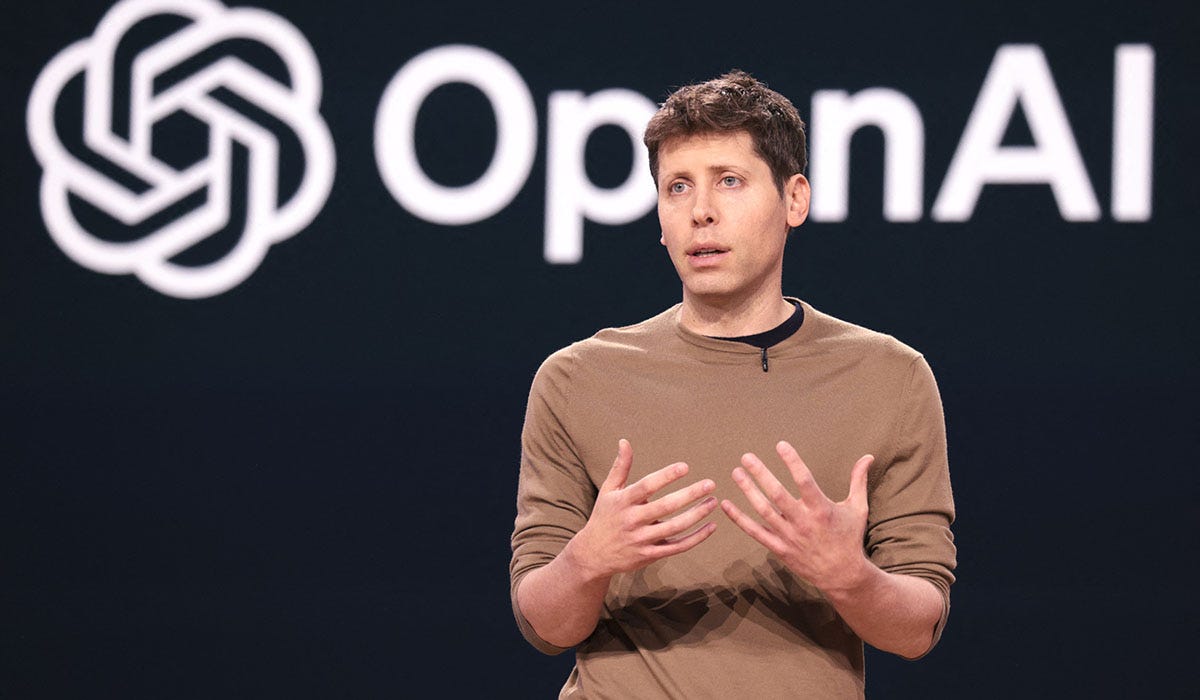
The CEO of OpenAI, Sam Altman, has defended himself against accusations of excessive energy consumption by artificial intelligence (AI) applications, arguing that training a human being also requires significant energy. According to Altman, if we count all the energy a human requires from birth until becoming productive—around 20 years, by his calculations—then AI is equally, or even more, energy-efficient. As might be expected, this analogy between machines and human beings has been widely criticised as dehumanising, since it suggests a moral equivalence between, for example, keeping a baby alive and training an AI system. However, I believe the critique needs to operate on a much deeper level.
The strength of Altman’s analogy is that it is technically correct, at least at first glance. From an energetic standpoint, both machines and living organisms are entities that require a continuous “intake” of energy in order to “function”, which in physical terms means performing work. What differs is the type of fuel required. Machines can run on wood, coal, oil, electricity… whereas human beings are far more constrained: our metabolism can only process what our enzymes are able to transform—namely food. We cannot eat coal or drink oil. Yet the biochemical process is essentially the same, and digesting a sugar cube releases roughly the same amount of chemical energy as burning it in open air, albeit through different mechanisms. This is why different forms of energy can be measured in the same unit—joules or calories, for example. From an energetic perspective, we are indeed comparable.
Far from being obscene, this point is central to understanding both the strengths and the vulnerabilities of contemporary societies. It also allows me to turn Altman’s argument on its head. Consider a basic example I often use: if Greek and Roman aristocracies could move from place to place without walking, it was because they had at their disposal a group of human slaves whose physical power transported their masters. Those slaves, of course, had to be fed continuously—and that was not always cheap. Today, those slaves have been replaced by vehicles which, thanks to their enormous physical power, can reach far higher speeds. But they too must be fed—only now with fossil fuels, or with electricity in the case of electric vehicles. To give a sense of scale, a 250-horsepower SUV operating at full power is equivalent to roughly 2,000 human slaves working simultaneously. Because fossil fuels have been relatively cheap—and because there are no moral scruples about “exploiting” them—the generalisation of these machines has enabled a massive rise in material living standards for much of society over the past 250 years. In that sense, the Anthropocene is also the age of the mass proliferation of energy slaves.
If this energetic equivalence grates on our common sense, it is precisely because we have naturalised what the anthropologist Alf Hornborg calls the “fetishism of machines”: we look away from the flows of energy and natural resources required to keep our machines running—from hairdryers to transport vehicles, computers and other electronic devices. The truth is that the maintenance of our entire technostructure — all those machines that sustain modern life, particularly in developed countries — depends on a continuous inflow of resources and energy, often extracted from poorer and more exploited parts of the world, and it generates environmental costs that are likewise externalised. And just as with our own bodies, if we stop taking in energy as “fuel,” machines become useless junk. Hornborg himself often recounts how, after the collapse of the Soviet Union and the local breakdown of supply chains, Russian farmers quickly realised that without diesel their tractors were little more than scrap metal.
We now know that the widespread adoption of fossil-fuel-powered machines has not only improved material living standards—by raising economic productivity to historically unprecedented levels—but has also, as the historian Tony Wrigley argued, opened Pandora’s box: the ecological impact has been colossal, beginning with climate change, which threatens life itself on the planet. The central civilisational challenge today is to transition to new renewable energy sources capable of powering our machines while sustaining forms of material well-being compatible with planetary boundaries. There is no greater historical urgency.
At this point, however, we might question whether we are truly enjoying that material well-being. There is no doubt that machines and technology are becoming ever more advanced, as the spectacular development of artificial intelligence demonstrates. Yet if we look at human working conditions, they have not changed so much over the decades—and where they have, it has often been for the worse: precarity, flexibility, exploitation. Human beings remain hamsters on the wheel of capitalist production, and machines are not liberating us; they are adapting to that tragic destiny. Here lies the explosive core of Sam Altman’s remark: what is AI really for?
Any technological advance is potentially emancipatory: insofar as it allows us to produce the same output in less time, it opens the door to more leisure and less work. The problem is that once technology is embedded within an institutional system such as capitalism, that door is closed, and all resources are directed towards producing more in the same amount of time—or in even more time, if socio-political conditions permit. This is what Altman implicitly suggests when he argues that a human being becomes productive only at the age of 20, presuming that all prior time is merely an investment of energy. What ultimately seems to matter, in this view, is the “productive” character of the instrument, whether machine or human. The critical issue is not that he compares the energy consumption of machines and human beings, but that he conceptualises both as necessary sacrifices for a higher good: private capitalist profit.
The problem, therefore, is not technology but capitalism. Even if alarm bells ring when machines and humans are placed on the same energetic plane, what is truly troubling is that we are not questioning the fact that machines—including artificial intelligence, a technology that requires a vast consumption of natural resources and energy—are deployed exclusively in the service of corporate profit. The choice is not between machines and humans, as the nineteenth-century Luddites believed, nor is it simply about the contemporary debate over job automation. The task is to build a society in which machines are “slaves” not only energetically but also politically.
In the end, technology and machines should serve to liberate human beings, not bind them ever more tightly to the hamster wheel of capitalism. The real issue is not the existence of energy slaves, but who controls them, for what purpose, and for whose benefit. Used differently, these same technologies could enable us to live better within planetary boundaries, reducing necessary working time and expanding leisure and fulfilment. Many of us call that possibility ecosocialism. It offers a far more humane horizon for life—and likely the only viable one.
It is a very important and realistic consideration about the actual situation of the world