

What cannot be seen from space
On photographing a planet while destroying it

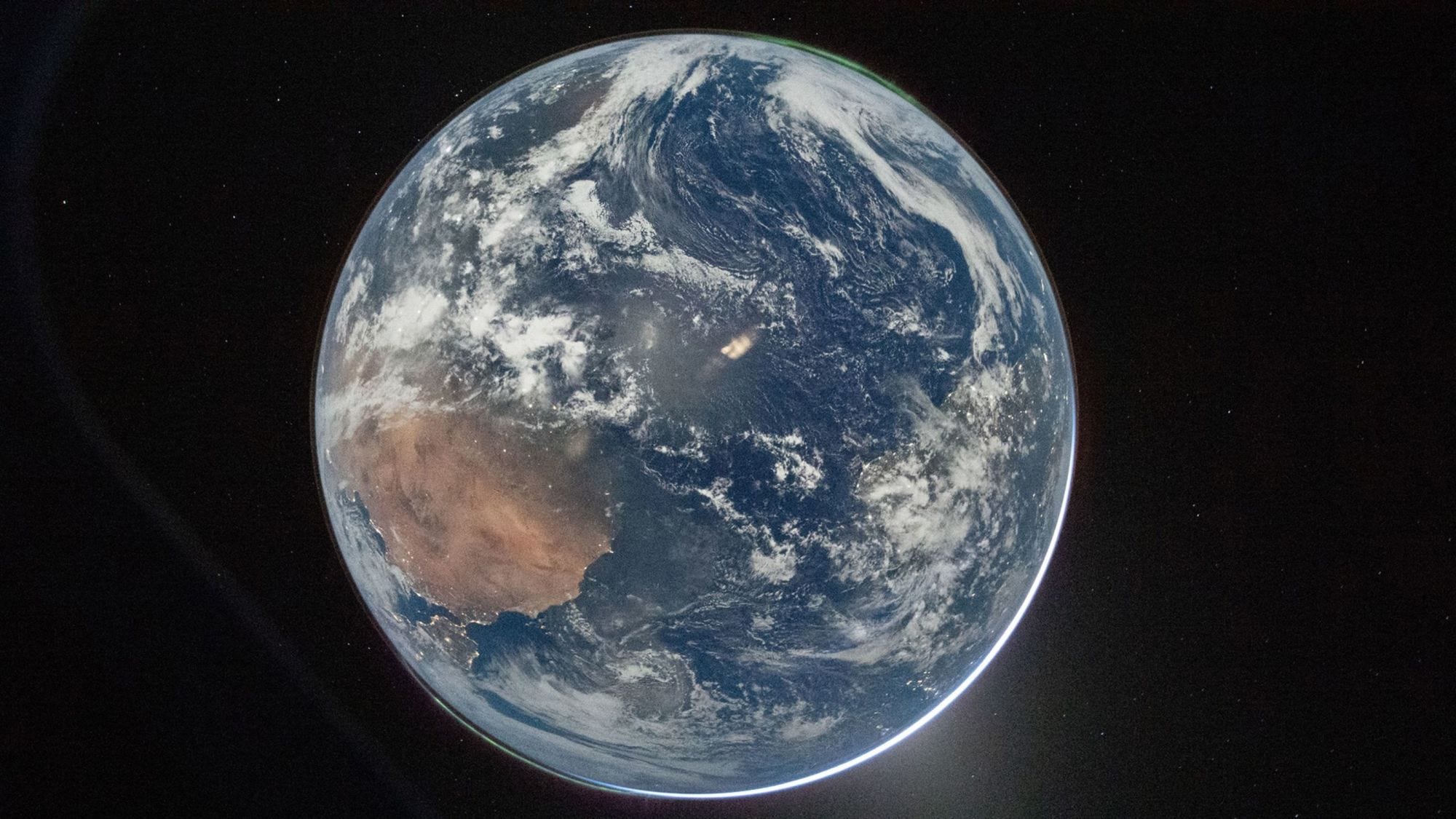
I enthusiastically showed my daughters the photographs of the Earth taken a few days ago by the Artemis II mission. What was enthusiasm for me translated, for them, into nothing more than genuine curiosity — albeit one that became especially compelling when they saw the beauty of the aurora borealis reflected in the images. In truth, they are still too young to grasp the significance of a photograph that reveals the fragility of our planet and of life itself.
Most of us are thoroughly familiar with the image of our planet, so we are not easily impressed either. It was very different for those who, in the nineteen-sixties and seventies, saw for the first time the various photographs of the Earth taken by the Apollo missions. The most famous of all was taken during the Apollo 17 mission in 1972: it depicted the entire planet and gave rise to the concept of the “blue marble.” In environmental studies, that period is known as the Second Copernican Revolution, defined by the fact that, thanks to certain technological instruments, we were able to see our own planet with our own eyes.
If the astronomical work of Copernicus, Kepler, Galileo and others had displaced the Earth from the centre of the universe, consigning it to a peripheral corner of the solar system, this second Copernican revolution redirected attention towards the Earth to assess, among other things, its exceptionality and fragility. It is hardly surprising that this had an enormous impact on the development of what we now know as Earth System science, and also on the emerging environmentalist movements: James Lovelock, for instance, acknowledged that these photographs encouraged him to put forward his famous Gaia hypothesis, according to which the Earth was an organic entity.
Thanks to the advances of science, we now know a great deal more about our planet. We know, for example, that the Earth needs only to move roughly five per cent closer to the Sun to trigger a runaway greenhouse effect, or the same distance farther away to turn it into a world of ice. We know that if it were somewhat larger, it would retain gases that would render the atmosphere unbreathable, and that if it were smaller, it would have lost the oxygen and water vapour we need. We know, in short, that life depends on an extraordinarily precarious equilibrium, protected among other things by a magnetic field that deflects lethal solar radiation and which, in passing, bestows those aurora borealis that my daughters admire and that seem drawn from a fairy tale.
When one is aware of such fragility, it is natural for conservationist and even humanist discourses to emerge. One of the Artemis II astronauts declared from space that “up here we are one single thing: Homo sapiens, all of us, regardless of where you come from or what you are like — we are one people.” Such assertions are true, of course, but they remain unrefined. It is the same discourse as fifty years ago — not free from ideology, still less so then, in the midst of the Cold War — yet one that fails to internalise all the things that have changed, nor indeed the things that have not.
In the early awakening of the environmentalist movement and the unfolding of Earth System science, it was understandable that attention should focus on a system as complex and fascinating as the Earth. What is more, we are still far from understanding how all the parameters of this life-sustaining system function and interact. But today we know enough about the principal danger — though not the only one — threatening our very existence: the emission of greenhouse gases and the consequent climate change. We also know the main cause of this excess of emissions: a model of production and consumption whose dynamic of unlimited growth is unsustainable within the planet’s limits. With good reason, the human species has been described as a geological force capable of altering the parameters of the Earth system, giving rise to the view held by many geologists that we live in the geological era of the Anthropocene.
That view is correct, but incomplete. Notions such as the Anthropocene run the risk of equating the responsibilities of every individual of the species Homo sapiens, as though neither power nor inequality existed within our community. On the contrary, some human groups bear greater responsibility than others for the situation in which we find ourselves: the wealthy nations that achieved their wealth through the uncontrolled emission of greenhouse gases; the large energy companies that deliberately concealed for decades their knowledge of the harm caused by burning fossil fuels; the countries that outsource their production so that ecological damage takes place elsewhere; the social classes that benefit from this political and economic order; the specific individuals whose luxury lifestyles carry carbon footprints larger than those of vast segments of the population put together… We could go on, but I trust the point is clear.
The fact is that whilst the astronauts of the American Artemis II mission were sharing their beautiful photographs of what planet Earth looks like from space, offering reflections on what unites us as a species, the President of the United States was threatening to destroy a millennia-old civilisation in a war he himself has initiated — without having yet explained why or to what end. The paradox is that the Artemis II mission is itself a propaganda device of American imperialism, so that one of the world’s greatest threats will also derive benefit and pride from this space venture. Two worlds will then intersect: destruction and conservation.
The day will come when my daughters understand that the beauty of the aurora borealis is also a sign of how fragile everything is: the magnetic field that generates it, the atmosphere we breathe, the equilibrium that permits life. And they will understand, I hope, that protecting that equilibrium is not an abstract or merely technical matter, but a profoundly political one. Behind every tonne of CO₂ lie concrete decisions, identifiable interests and unequal responsibilities. The blue marble is not breaking on its own. Quite the opposite: an economic system serving very specific interests is cracking and destroying it whilst others photograph it.
Well observed. I think in our bones we know it - although many choose delusion. Truth does come out and it is written in the landscape of life we all inhabit. My students know it even if they can't articulate it - it is unavoidable. I do hope your - and mine - and the world's children get to live a decent future. Right now it is all very precarious and the current lunacy bodes ill. Thanks for your work.
ES UN ARTÍCULO MUY ADECUADO A LAS NECESIDADES QUE TIENE LA HUMANIDAD EN EL MOMENTO PRESENTE,PUES DEBEMOS CONSERVAR EL MEDIO AMBIENTE LIMPIO PARA CONSERVAR LA SALUD