

Why is Spain going to regularise the status of 500,000 immigrants?
How Spain’s migrant regularisation plan infuriates Elon Musk — and exposes the far-right disinformation machine

The West is experiencing the advance of a global reactionary wave. The far-right movement is in government in the United States and in some European countries, such as Italy and Hungary. It is also leading some opinion polls in France, the United Kingdom and Germany, and it aspires to govern soon — either in coalition or alone — even in Mediterranean countries such as Spain or Portugal. In Latin America, countries such as Argentina and Chile have also fallen into its grip, and in others, such as Brazil, it could return to power soon. In all these cases, the main driver of its growth — though not the only one — is anti-immigration sentiment.
This reactionary movement relies on very powerful actors to spread disinformation and hatred. The most prominent is Elon Musk, who repeatedly interferes in domestic politics in the United Kingdom — his particular obsession — and in other European countries, aiming to shore up support for the far right. His social network is a cesspit of disinformation that contaminates every household. His xenophobic and conspiratorial narrative claims that “white people” are disappearing, that immigrants will replace the native population, and that this is precisely the goal of the so-called woke left.
In this context, the Spanish government has done something that has irritated Elon Musk: it has announced it will approve the regularisation of 500,000 immigrants currently living in Spain without legal status. This stands in sharp contrast to the dominant public policies elsewhere, which — even when led by progressive parties, as in the case of Keir Starmer in the UK — seek to curb migration flows. But in none of these countries are such policies achieving their stated objectives; all they are doing is increasing fear, paranoia and authoritarianism.
The UK’s anti-immigration policies did not manage to stop migration flows; they merely transformed them: European immigration fell, while non-European immigration increased sharply, as the following chart shows.
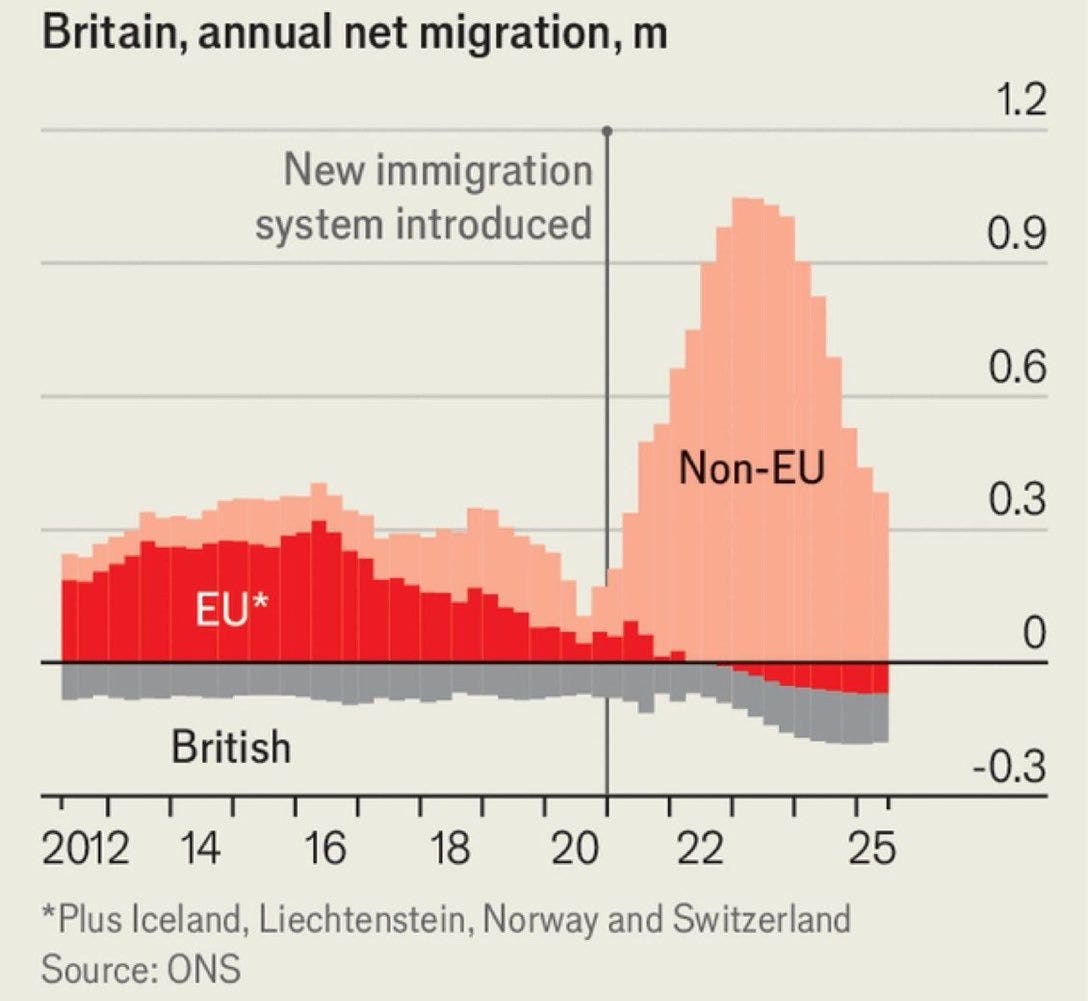
Tougher entry requirements, lengthy bureaucracy and a hostile climate towards migrants have discouraged people from Europe from moving to the UK — I myself am an example, since after stepping down as a minister I had planned to move to the UK with my family, where my wife even holds an NHS GP licence — but they did not prevent the arrival of migrants from elsewhere. Why?
The main reason is that migrants do not arrive in Spain — or in other similar countries — by chance. The vast majority move to places where there is demand for labour. This is primarily an economic logic, even though other factors (political or social) may also be at play. In Spain today, there is a strong demand for workers that cannot be met by the domestic workforce (in agriculture, tourism, construction, delivery services, domestic and care work, childcare and elder care). These jobs are largely complementary to existing employment, which means that the far right’s claim that “they take our jobs” is not justified. Spain is currently creating more jobs than any other EU country, and in some years, almost all of that job creation has been taken up by immigrants.
This means that immigration is an endogenous variable in economic dynamics: if the economy grows and demands labour, it attracts more immigration (and the reverse: if GDP falls, migration follows it something later). We can see this in the following chart.
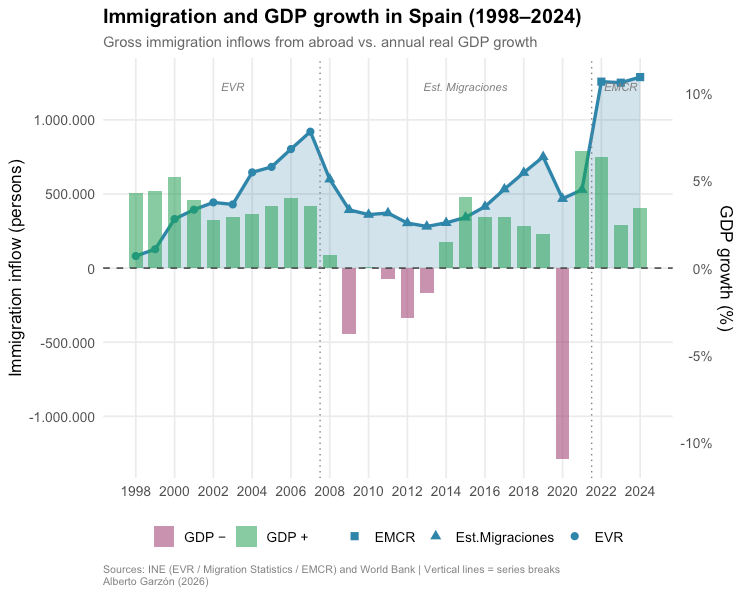
In addition, most immigrants enter their destination country legally: they arrive on a tourist visa and then stay longer than permitted, trying to rebuild their lives. There is no way to control this dynamic without violating democratic principles and turning the country into an authoritarian police state (and even then, as in the United States, the most likely outcome is still unfilled jobs and people forced into hiding). What will stop coming is immigration that has better opportunities elsewhere.
Restrictive immigration policies therefore damage the economy and leave migrants defenceless, forcing them to work without papers and at the mercy of their employers, usually in very poor conditions. And yet these migrants still contribute to the country through their labour and through indirect taxes, creating a situation of labour exploitation and political cynicism.
Spain has made a decision that is both economically and morally right. Elon Musk has criticised the Spanish government’s regularisation policy, and the far right speaks of an “invasion”: their rhetoric is rooted in an ethnic nationalism that lies at the heart of all forms of fascism. Yet this far right does not know where to draw the boundary of what counts as “national” (those born in Spain? also the children of immigrants?), and it therefore quickly turns its hatred against the “internal enemy” — the multicultural left. They no longer ask whether we are Spanish, but rather “what kind of Spaniards we are”.
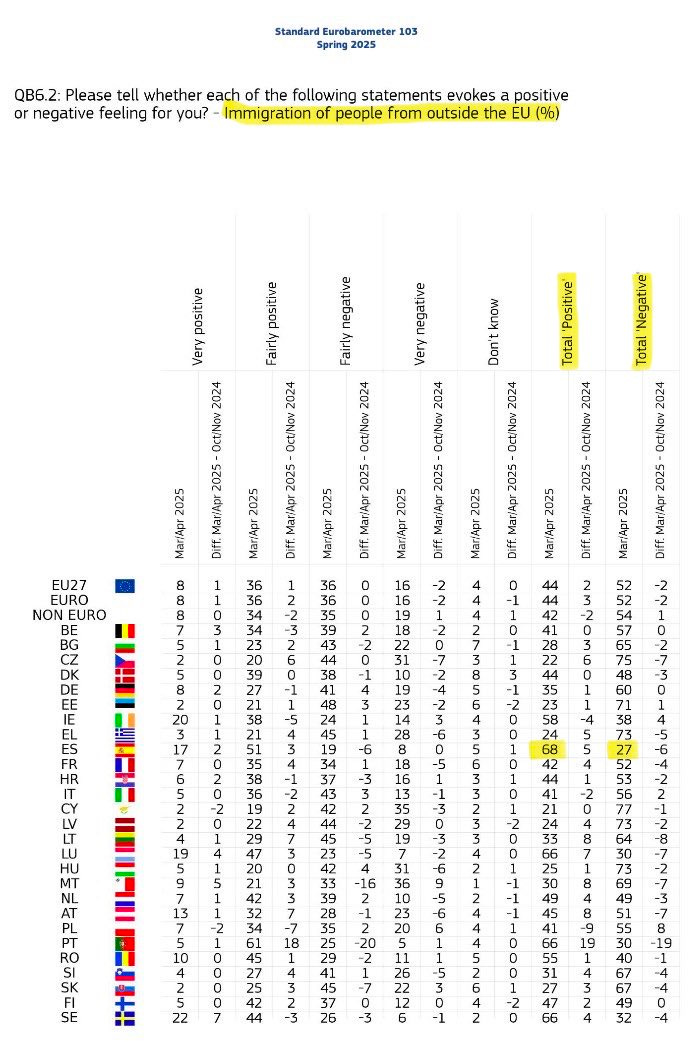
To Spain’s credit, it is the EU country with the most positive attitudes towards immigrants. Anti-immigrant hatred exists and is dangerous, but it remains a very small minority. What explains this “exceptionalism”? At least two factors. First, most immigrants come from culturally similar backgrounds, especially Latin America. Second, Spain’s Catholic tradition implicitly upholds the doctrine of imago Dei — the idea that we are all children of God, regardless of where we are born. In fact, the Spanish Catholic Church, so reactionary on other issues (such as sexual rights), has supported the regularisation of immigrants.
Finally, in case the reactionaries do come to power in Spain — although we must work to prevent that — this measure will also make it harder for them to exert the kind of pressure and attacks against undocumented migrants that Trump is carrying out in the United States. Given what we are seeing there, at this point, it is quite literally a way of saving lives.
Considero que la regularización es un paso efectivo para acabar con el trabajo en negro, que está maltratando a miles de inmigrantes, privándoles de muchos derechos laborales: contrato indefinido, vacaciones pagadas, pagas extraordinarias de diciembre y julio, horas extraordinarias registradas, etc.