

Why the German Model Has Stopped Working
Not bureaucracy, not the welfare state: what is unravelling in Germany is its place in the international division of labour.

Volkswagen’s board will discuss this week the announced dismissal of 100,000 workers worldwide, along with the closure of up to four vehicle manufacturing plants in Germany (three Volkswagen and one Audi). This is a fresh episode in the profound restructuring that German industry is undergoing after several years of economic stagnation.
Although the conservative Chancellor Merz attributes this situation to bureaucracy and to the supposed generosity of the welfare state, the German crisis cannot be understood without reference to growing international competition, particularly from China. More than that, it constitutes one of the most visible symptoms of the shift now taking place in the international division of labour.
It is worth recalling that the international division of labour is a notion that represents the way in which the world-economy is “ordered”, and it is never static: it expresses a productive hierarchy in which some countries concentrate on the most technologically complex activities while others remain specialised in lower-value-added tasks. This carries implications of both economic and ecological inequality, but what matters here is that this hierarchy is changing. China’s industrial ascent and the United States' protectionist turn are eroding the export model that made Germany Europe’s great economic power.
We are talking about a problem that is not only German but European. The current European institutions and their economic integration cannot be understood without the central role historically played by both France and Germany, especially the latter since reunification. Indeed, since the 1990s Germany has been Europe’s undisputed economic power, its influence over the others visible in the ordoliberal spirit—a mercantilist neoliberalism—that dominates institutions such as the European Central Bank as well as European rules and regulations. During the 2008-2010 crisis and the subsequent euro crisis, we Mediterranean countries largely bore the consequences of this conservative economic vision, so deeply rooted in the German economic imagination. Those were years in which the German economy seemed to be the only one capable of withstanding the economic crisis, turning Chancellor Merkel and her economic model into the canonical reference for what apparently did “work”.
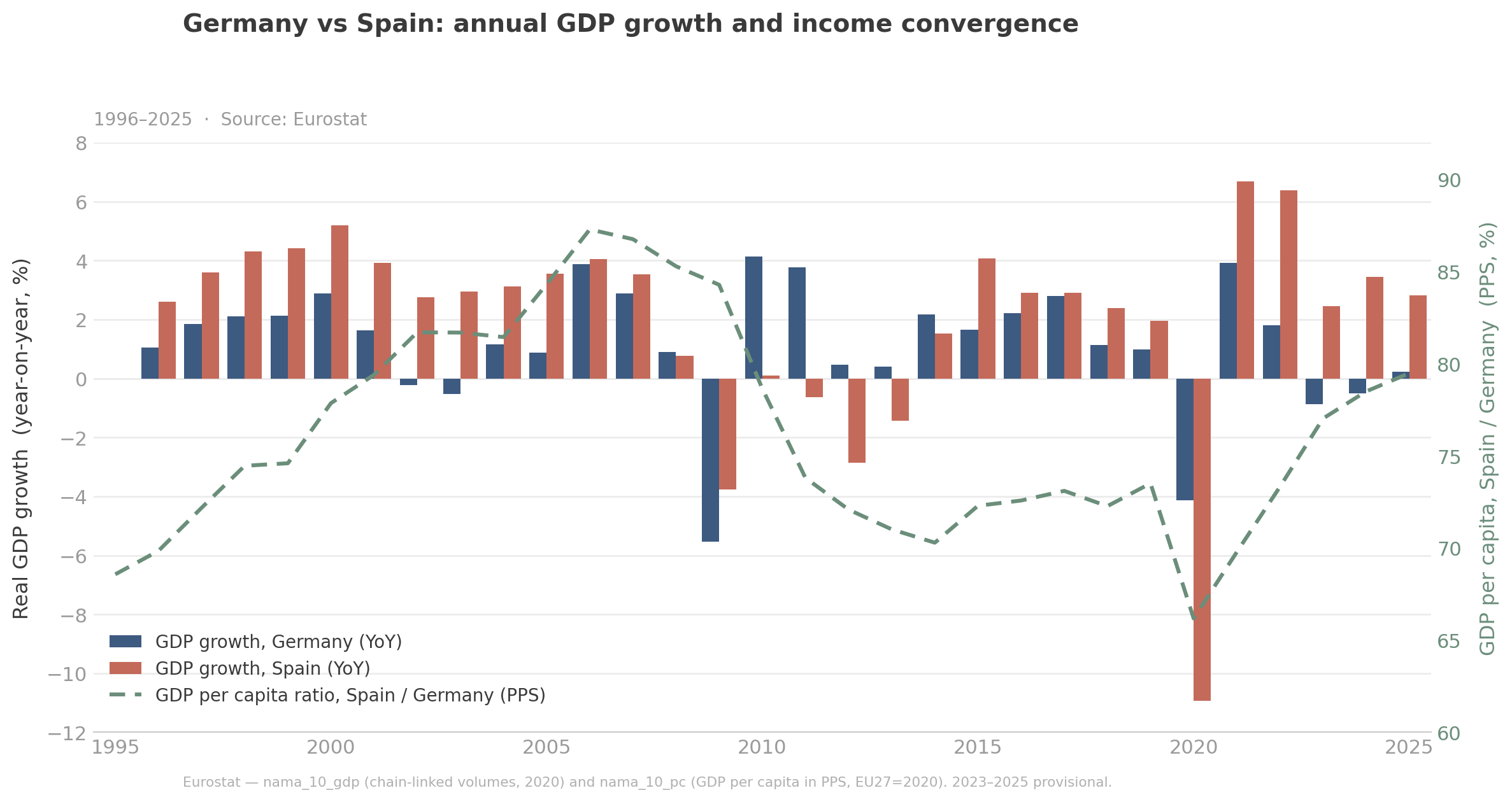
Yet one of the most visible symptoms of the current deterioration of the German model is its loss of economic dynamism. While Spain has recorded higher GDP growth for much of the past few decades, Germany has spent several years in recession. So much so that, following the economic recovery of 2015, Spain has grown faster than Germany in practically every year. We should be precise: this has not made the two economies alike, since the Spanish one starts from a substantially lower level. As the chart below shows, Spain’s GDP per capita is still 80% of Germany’s (in purchasing power parity terms).
The current situation is paradoxical because, as I have mentioned, the German model has habitually been presented as a success story. On the one hand, German industry is the most powerful in all of Europe and is concentrated in technologically intensive sectors. On the other, economic growth has been based on a strong orientation towards exporting those industrial goods (cars most notably, but also machinery, biotechnology and other high value-added products). The global value chains organised by German firms have been structured according to that logic, with subsidiaries in countries such as Spain devoted to assembly and other lower-value segments while the head offices in Germany retained the most valuable segments and the largest profits. The eastward expansion of those global value chains—taking advantage of geographical proximity and, above all, cheaper labour—has shaped the European economy over the past two decades. The European Union’s enlargement to the east is closely bound up with this new function assigned to the post-Soviet economies.
That specialisation turned Germany into an economy extraordinarily dependent on external demand. So long as international trade was growing and its principal markets remained dynamic, the model worked. But that same dependence makes it especially vulnerable when the conditions of international competition change—and that is what we are now seeing.
Indeed, this order of things worked as long as Germany had no economic rival in its dominant sectors and could draw on the cheap labour and natural resources it extracted from other countries. Russian fossil fuels have been just as important a support as the offshoring of industrial segments in the drive to maximise profits. China’s incorporation into the world economy in 2001 allowed German firms not only to outsource production to “cheaper” locations, but also to expand their sales markets, since an industrialising economy such as China’s required vast quantities of machinery and other products in which Germany dominated production. While that was happening, China devoted itself to producing and exporting low value-added goods—toys, textiles, furniture, basic electronics—none of which competed seriously with German production. It was, apparently, a win-win for both Germany and China.
The German problem arose once China began to emerge as a producer of high-value-added goods: electric vehicles, energy transition technologies, and chemical and pharmaceutical products that now compete with German ones. For two decades, China used the rents generated by its rapid industrialisation and export expansion to finance a gigantic industrial policy, invest in technological capabilities, and climb progressively towards higher-value-added segments. Moreover, the specific circumstances of Chinese production—a state-planned industrial policy and backing for both private and public firms, together with enormous economies of scale—have given Chinese products a considerable advantage. As if that were not enough, China is not only pushing its economy towards high-technology production but also seeking to control the entire supply chain: from critical minerals through to intermediate inputs. The Chinese strategy aims at a high degree of self-sufficiency, which has led it to reduce its dependence on imports that previously came from Germany, among others. To make matters worse, the United States government—which faces the same competition from China—has imposed 15% tariffs on European production, thereby narrowing that market as well (in 2024, it was the destination of 11% of German exports).
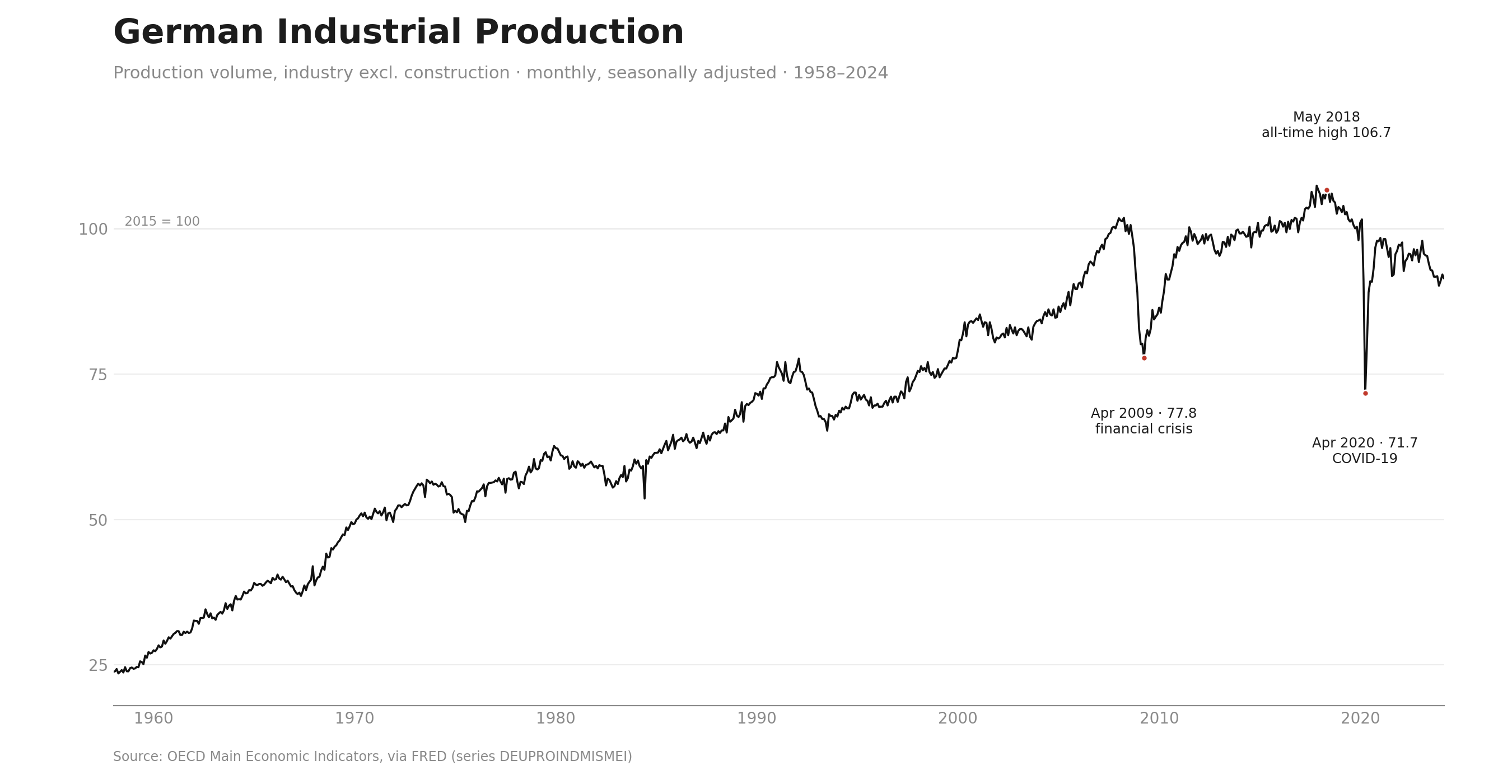
The indicators of German industrial production leave no room for doubt. As the chart below shows, industrial production has been in sustained decline since 2018 and has now fallen by a cumulative 14%. The external demand that sustained its growth model has collapsed—with China and the United States prominent among the causes—and nothing suggests the trend will reverse.
All these events are unfolding very rapidly in historical terms, and they raise unsettling questions that are rarely the subject of political discussion. What impact does this transformation have on the rest of Europe’s economies, especially those intimately connected to Germany's, as is the case in the countries of the East? What kind of consequences will be unleashed by a mercantilist reaction, of the American sort, on the part of the European Union? How does it affect energy transition trajectories that most renewable infrastructure is produced in China? What sociopolitical effects follow from a region such as Europe, once the centre of the world-system, being “demoted” within the new international division of labour? Is the rise of the far right in Germany connected to this crisis of the export model and to that sense of political and economic downgrading?
At bottom, this case allows us to recall that the capitalist economic system is an institution in which everyone competes against everyone, and that there are respects in which the rules operate as a zero-sum game. It is not only a question of ecological limits, which I repeatedly insist on, but also of the fact that not every country can be a net exporter. One country’s exports are another’s imports, so that the exaltation of a model based on exporting more than one imports—Germany, China—is sustained only at the cost of ferocious competition and the existence of other countries that import more than they export. And yet, in Europe we have for many years been encouraged to believe that the German growth model was the undisputed benchmark, the mirror in which to see how things are done properly. That model is now in crisis because there are competitors that are fiercer and more capable, so that, in the new international division of labour—with China’s ascent and the United States’ neomercantilist attempt at self-defence—Germany has been left trapped in old inertias.
All of this is one of the most visible symptoms that the economic architecture which organised Europe over the past three decades is ceasing to exist. Understanding that transformation and being able to address it will be among the most important intellectual and political tasks of the coming years.
Muy bien análisis y pertinente.
Muchas gracias Alberto , muy claro e informativo.